

I don’t know about you, but I’ve had just about enough of these pompous establishment Democrats defending their party severing the last vestiges of its rationality and patriotism to trans itself into Commie ISIS.
We’ve seen all this before. The union of Marxists and Islamists has a long history, a high-low combo of academics with a surplus of graduate degrees and guilt entertained by the youthful passions of the proletariat into supporting the vilest anti-human agenda devised in modern times.
This way to the gulag, comrade – walk faster, you know you deserve it.
The Abdul El-Sayed victory in Michigan, even if it came more narrowly than expected and was rebuffed by rural and black voters, is just the confirmation of what was already clear. Today the organizing energy of the Democratic Party – the party that less than a generation ago stood shoulder to shoulder with fellow Republicans and Independents against the Reds and the terror-supporters alike – is driven by a group of craven, manipulative liars and a bevy of followers whose understanding of history doesn’t start til iPhone 6.
These wannabe red diaper babies want to run back the losing side in the Nixon-Khrushchev kitchen debate and repackage it for morons on TikTok, and they do it well. Pick your reasoning for why they do it. Is it all to ease the horror of their meaningless existence by creating a community of followers who hang on their words of hate for people who are more successful than they are?
Whatever is wrong in your life, you can blame it on a corporation, a billionaire, or a Jew. Sometimes you hit the jackpot with all three at once.
This isn’t crazy. This isn’t radical. It’s the Democratic mainstream now. And after the results of the major primary elections across the country, it’s a genuine wave that will swamp a once truly American party that held Jefferson-Jackson Day dinners every spring until Donald Trump came along and liked them both.
The man who helped usher in that era of post-American politician, David Axelrod, took to the CNN airwaves last night to lecture the country on why it’s so bad that American Jews are spending money defending their interests. Keeping in mind that the overwhelming majority of AIPAC dollars (again, in the case of last night’s primaries) have always gone to Democratic politicians, Axelrod’s smear that this represents “foreign influence” found a fitting rebuttal from Van Jones.
Whether you care about Israel or not, the point for Americans is the weaponization that anti-Semites have achieved within the Democratic and, with less success, attempted to achieve within the Republican coalitions. Michigan proved once again that the AIPAC approach to American politics is a loser. Their highest-backed candidate just lost to an army of Democratic Socialist influencers, for whom FOMO is the most powerful motivation, who anointed a dog-electrocuting 9/11-supporting double-breasted nepo baby as their activist champion. What was October 7th but just some bros on Blue Chew flying Mario Karts into a festival? What’s so wrong with that? The streams did numbers after all.

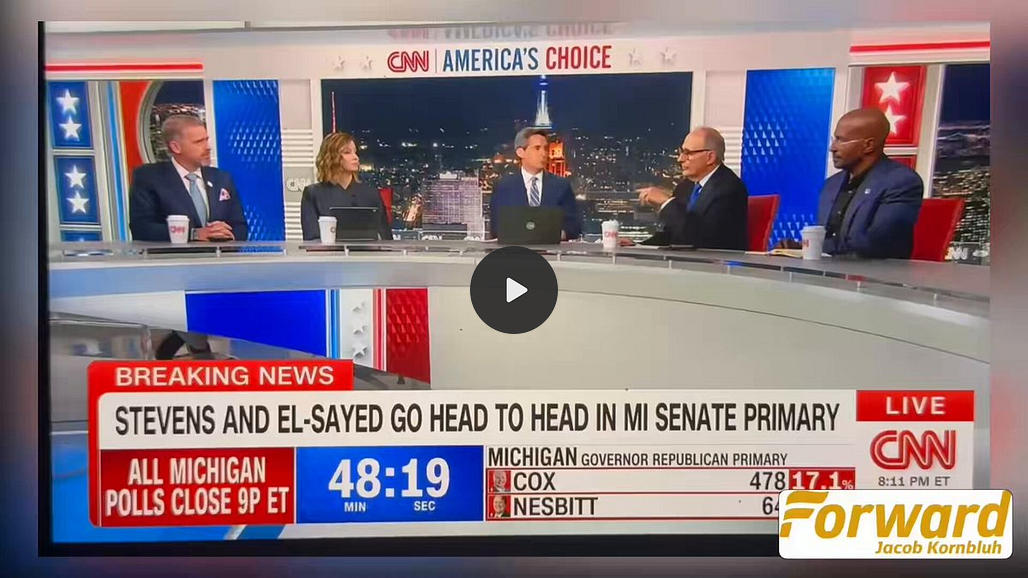
Michigan’s outcome was actually good for Democratic hopes in the fall, though, because it will likely force Abdul El-Sayed to do something he wouldn’t have done otherwise: moderate his tone. In the past few weeks, ebullient with the aura of inevitability (thanks in part to what now looks like a bunch of juiced internal polls), El-Sayed was taking on an attitude of “I don’t need you any more” toward the party.
This is classic dumb savior complex politician stuff, complete with the Beto “born to be in it” energy. But this outcome will likely temper that heat and push him back towards the Democratic politicians he needs to get him over the finish line — to give him the veneer of normalcy he needs to win Michigan. And they’ll be there for him.
For the rest of us, we should recognize what a danger it is to have a major party just become Commie ISIS, a coalition that joins all the people who want to seize your property, eliminate the nuclear family, re-educate your children, and also sometimes slaughter a goat in their backyard.
As an independent, I’ve voted for Republicans, Democrats, Libertarians, and The Rock.
My question going into a voting booth is always what a good friend calls “the beach test”: “Can you imagine this person on the beach with a machine gun fighting back against the Chinese invasion?” It obviously applied to the likes of Jim Webb. But do any of these Democrats pass that test today? Forget it – they’d be turning those guns around.
Al Sharpton used to warn Democrats about the Republican Party hijacking the Bible and the Flag. Today’s Democrats just don’t care. They have other flags to follow.
The Real Reason Every Restaurant Tastes The Same
There’s a narrative making the rounds on social media that tries to explain why so many restaurants taste the same. The villain, we’re told, is Sysco. According to the internet, one giant food distributor supplies every restaurant in America with the same frozen food, which is why every mozzarella stick, onion ring, chicken tender, and burger tastes identical. It’s certainly a satisfying story, but unfortunately it’s not that simple.
I don’t have any particular interest in defending Sysco. In fact, I have plenty of criticisms of large food distributors in general, from their unwillingness to support local producers to their lack of general customer service, but blaming Sysco for what has happened to the American restaurant industry is like blaming UPS because every package looks the same. Sysco isn’t creating the demand for generic pre-processed junk; it’s responding to the (government-manipulated) market.
If you really want to understand why restaurant food has become so homogenized, you have to stop looking at the distributor and start looking at the incentives that created the demand in the first place. As economist Thomas Sowell has often argued, people respond to incentives. You don’t change outcomes by pretending human nature is different than it is; you change the incentive structure, and behavior follows.
Over the past 15 years, the economics of running a restaurant have changed dramatically. Labor costs have blown up, food costs have nearly doubled — rent, insurance, utilities, workers’ compensation, credit card fees, compliance costs, and government regulations have all increased. Restaurant margins, which were never especially generous to begin with, have been squeezed thinner and thinner. Sometimes it feels like we are running a non-profit, and I don’t mean a 501(c)(3).
For decades, restaurants could survive by preparing food from scratch every day. They employed prep cooks who chopped onions, breaded chicken, cut fries, made sauces, rolled meatballs, and prepared desserts using the owners’ recipes. That labor was never “cheap,” but it was manageable.
Today, that same labor has become one of the hardest expenses to justify. When labor and food already consume well over half of every dollar that comes through the register (typically 60-70 cents on every dollar), owners begin to question those foundational operations: “Can someone else do this cheaper? Can someone do this absent the excess workers’ compensation costs or the risk of changing labor violations?”
That’s where the food manufacturers find their opening. Restaurant owners decided they could buy labor along with their products, especially if they are mass-produced. The onion rings arrive already breaded, the chicken already par-fried, the fish already dusted in cornmeal, and the mozzarella sticks already assembled (complete with TikTok-ready cheese pull). Sauces are made in massive facilities, packaged, labeled under different brands, and shipped through distributors across the country. Whether the box arrives from Sysco, US Foods, Performance Food Group, Shamrock Foods, or a regional distributor is almost beside the point; in many cases, those products originated from the very same manufacturers, just with different labels.
Distributors didn’t invent this model; the market demanded it because the economics forced them to. This had become a more prevalent industry trend, but COVID nitro-boosted it. During the pandemic, labor became even scarcer (as people were paid not to work), while supply chains became entirely unpredictable. Restaurants outsourced everything they possibly could just to survive. Sauces moved to co-packers — products that once required skilled kitchen labor became commodities. The government loved this because now they had only a few companies to control, as opposed to thousands of smaller ones. This is why I suggest the COVID economy was a corporatists’ dream: It killed the “artisanal” nature of the restaurant industry.
More From The Daily Wire:
• Daily Wire: The Real Reason Young Men Are Struggling To Succeed
• Daily Wire: Trump Is Right About Britain’s Immigration Invasion
• Daily Wire: Red State’s Income Tax Showdown Ends In A Landslide
• Daily Wire: Dem Voters Pick Another Radical Leftist In Crucial House Race
• Daily Wire: Crowd Roars As El-Sayed Drops An ‘Inshallah’ In Election Night Speech
• Daily Wire: We Deserve More Competition In TV, Not More Paywalls From Big Tech
• Daily Wire: Data Centers Are Not The Erin Brockovich Conspiracy Sequel America’s Enemies Hope For
• Daily Wire: For Aaron Rodgers, Vindication Has A Pittsburgh Accent
• Daily Wire: How Sophie Cunningham Became The WNBA’s Biggest Target
• Daily Wire: Sophie Cunningham Is No One’s Culture War Punching Bag
• Daily Wire: Sixty Years Later, One Beatles Album Still Leaves The Rest Behind