I will lay my cards out clearly: I am strongly for Hasan’s public execution. I am indifferent as to whether the livestream component is right or wrong. I believe people of good will exist on both sides and can make strong arguments for or against. If the live-streaming component were reversed, I wouldn’t be upset, as I think it’s permissible — not obligatory.
But public outcry that reduces public execution to a “spectacle” vastly undervalues the magnitude of Hasan’s offense. It is true that concerns about the macabre, bloodlust, and prurience are real. It is right and good to warn against turning a public execution into an experiment in unbridled machismo. No one should derive joy or entertainment from watching another human die, even if the conditions are just. A public execution is a solemn act of restitution, not a spectacle.
To those making accusations that public executions are a “spectacle,” I would simply warn them against committing “chronological snobbery” that C. S. Lewis warned against — the mistaken idea that the present age is more enlightened than previous times. To that, I would simply say, our society is no more morally enlightened than biblical times, where execution was public (Lev. 24:14; Num. 15:35–36; Deut. 17:5; 21:21; 22:24) and done so that “all Israel shall hear and fear and never again do any such wickedness as this among you” (Deut. 13:11) — in other words, deterrence. To pick and choose Old Testament maxims, like treating the foreigner justly, only to then turn your back on practices that the same Old Testament grounds in the retributive justice principles of natural law (Gen. 9:5-6), is simple partiality. The Bible does not permit being just and compassionate in one situation and then endorsing injustice or vindictiveness elsewhere. If the Bible endorses public execution in some general way, it is not intrinsically immoral. Moral seamlessness underlies the full biblical canon, even as we interpret moral principles carefully. A humble posture would ask why civilizations before us all practiced something that we now consider barbaric and, further, assess whether the therapeutic nature of punishment that now views the condemned as “patients” to be “healed” has not eclipsed what punishment is really for — balancing the scales of justice for the sake of public safety and the common good.
The argument here is not that the Bible demands public execution today in the exact form or that the witness of history is infallible. Claiming so confuses Israel’s law-covenant with the modern nation-state and views history alone as its own moral justification. Just because something has been practiced does not mean it must be practiced today; it should prompt us to ask deeper questions about why such execution methods were used. History does teach, and we are obligated to learn the right lessons. At the same time, anyone who believes we can dispense with the principles of human dignity, public justice, public accountability, and deterrence ignores timeless principles the Bible and modern statecraft continue to rely upon (Rom. 13:1-7).
Even so, concerns about what the event couldbecome do not negate the legitimate public interest in witnessing justice carried out — and in the public reckoning and assuagement that follows. Hasan’s crime was public in nature and requires public satisfaction.
The condemned in focus in this case is no ordinary murderer. He committed both treason and terrorism, making his crime an offense against the body politic on a scale beyond that of an ordinary murder. A soldier sworn to defend the nation who turns against it by murdering those likewise called to its defense has committed an offense of such a horrific kind that I am not troubled by giving its punishment greater symbolic weight in the public mind. If that means a livestream, so be it.
Whether I watch it or not, I believe there are good reasons for the livestream. I would argue on jurisdictional grounds. Because I believe capital punishment should be public, who should view the execution should be determined by the political community’s own interests. In other words, Tennesseans should have the ability to see a Tennessean murderer executed.
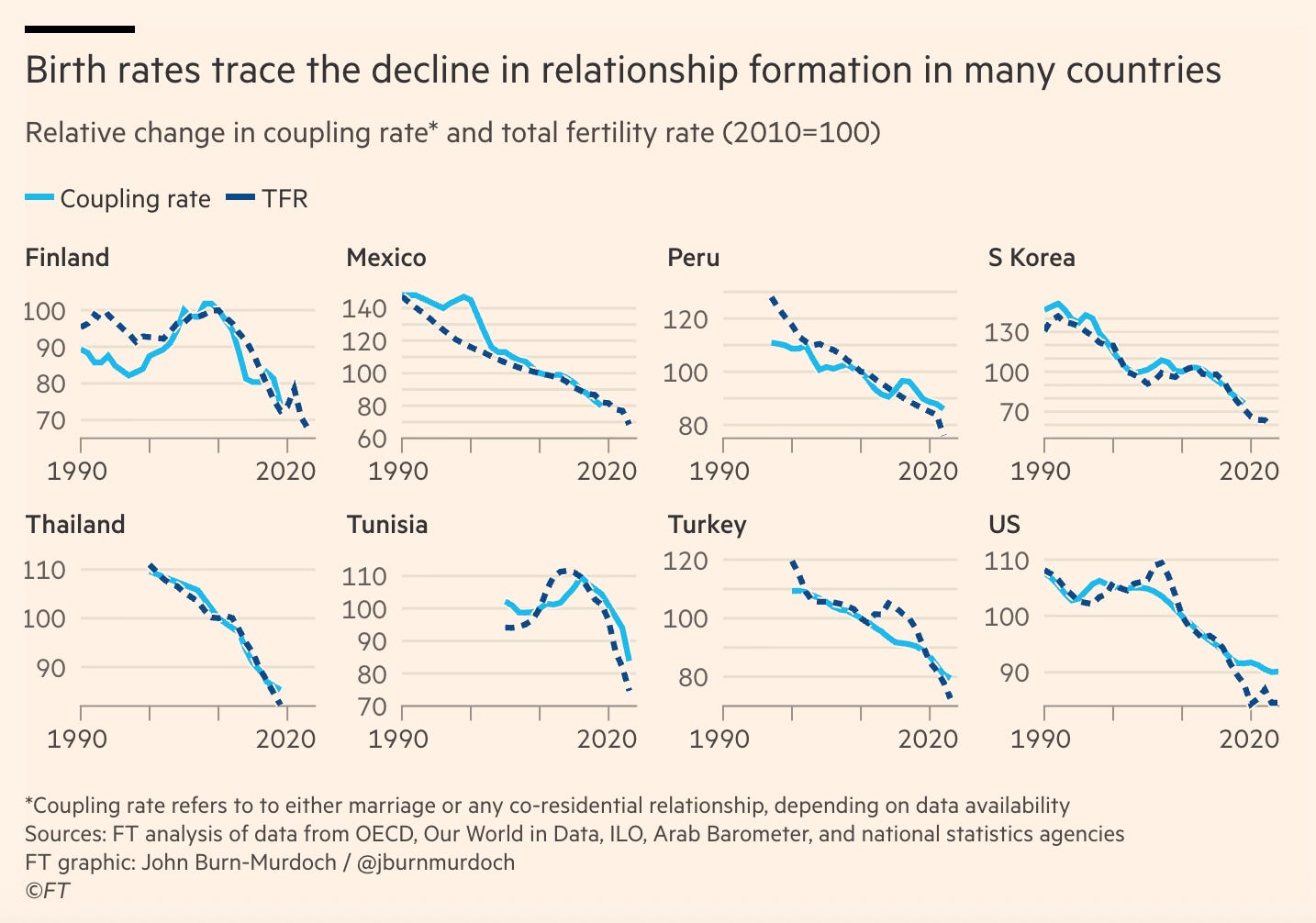
I care about the decline of coupling and marriage not because I consider myself a strict evangelist of matrimony—I think people should do what they can to enjoy themselves without hurting others—but rather because I think it bears on two of the most important questions about the future: (1) How many people exist, and (2) how happy are they? The relationship between romance and births is practically linear. Since 1990, Burn-Murdoch has shown, the decline of births traces the decline of relationship formation across many countries. Fewer relationships mean fewer people, and accelerating population declines around the world are, somewhat like climate change, a slowly accumulating phenomenon that will almost certainly shape the future of economics, technology, and the texture of human existence.
Then, there’s the mushy yet momentous question of whether people actually enjoy their existence. Self-reported happiness is declining in the west, and particularly in the U.S. Reviewing several decades of General Social Survey data, the economist Sam Peltzman came to the conclusion that “most of the overall downturn [in life satisfaction] is attributable to decline in marriage post-2000.” Reviewing Peltzman’s work, The Atlantic’s Olga Khazan provided some useful context:
One paper alone might be easy enough to dismiss, but this is a fairly consistent finding dating back decades in social-science research: Marriedpeoplearehappier. Period.
If the decline of coupling is upstream of both falling births and falling happiness, then the most important question is what’s happening at the source. In his new book Generation Uncoupled, Daniel Cox, a public opinion researcher and director of the Survey Center on American Life, considers a range of causes that span technology, culture, media, economics, and politics. In today’s interview, we talk about all of that.
In the end, we talk about men—especially low-income men without a diploma. “No group appears to be struggling more on the dating market than young men without college degrees,” Cox told me. “Compared to their college-educated peers, they are far more likely to be single and far less likely to have gone on a date in the last 12 months.” One reason is that, even after decades of rising female economic power, women in the dating market still value men’s economic potential more than height, politics, religion, or education, and low-income men without college degrees are often less affluent than the women in their neighborhoods and social circles. The decline of marriage cannot be reduced to any one thing, but it cannot be fully explained without considering the decline of what the sociologist William Julius Wilson once called “marriageable men.”
Obama knew that his power would be in identifying with the black guy, even though that black guy, in my cynicism, was not part of the American line; he was from Kenya. I have a true connection to slavery. My kid is white, but my great-grandfather was born into slavery. So I know that power very well because I have a choice, right? Nikole Hannah-Jones had that choice: white mother, black father, and a middle-class upbringing. So pretty similar to mine. She decided she identified with the black guy, and so white guilt made Nikole Hannah-Jones possible.
Nikole Hannah-Jones played the black side of the coin — the black power side of that coin. And she knew that if she were to go to the black side, she was going to have to follow that black power politic very militantly. Slavery must be everywhere. We got the 1619 Project, which went into almost every school. So if you want to understand the power of white guilt, because what she was doing was giving the white education power structure — the institution — its innocence. You are right, Nikole; we are a profoundly systemic racist nation. We must educate every kid. We must ground the founding of our nation in slavery.
So if that’s the object or the basis, how do we get past that?
I think that the answer really is to first understand the power of white guilt and start addressing it. And now, what makes white guilt very difficult for people, and what makes suicidal empathy so attractive, is that suicidal empathy is a diagnosis. They usually say, “Ah, that guy on the Left, he’s crazy. That’s suicidal empathy.” White guilt doesn’t do that. White guilt states, “What are you going to do? You?” Now I’m not talking about them. I’m talking about you. What are you, as the individual, going to do? Because all these years you said, “As a white man, I cannot say this or do this, or I’ll be a racist. Or, as a black man, I cannot say or do this, or I’ll be your Uncle Tom.” So we kept quiet, and we kept people, as my father says, deferential.
We kept deferring to people like Nikole Hannah-Jones. We didn’t want to get fired. I’m not minimizing the price that people have had to pay. I mean, my own father paid the price. I paid the price in a smaller way, so I know the price, but at the same time, if we’re not really going to pay that price in the short term — because what happened to our country, we’ve seen a decline. So I would say the way out really is to understand where we are, but also to understand that we have white guilt inside our brain. What I mean by that is that we police ourselves.
The other way is people saying, “I’m going to become tribal just like them and become just a white identity. I’m embracing the white identity.” The only way out for us is to become American, for us to really become unapologetic about the American principles, which are the greatest principles, the most universal principles, in the world. And I know people may think it’s kumbaya or something like that, but really, what else is there? The Bible tells you to do the same thing. If we compromise the Bible, we compromise the American principle. Right now we’ve got to stop compromising on that. And that’s the challenge of living in freedom. And that’s the way we have to, in a collective sense as a society, start living by the principle.
“As the world changes, the forms of corruption also gradually become more cunning, more difficult to point out - but they certainly do not become better.”