The latest edition of The Big Ben Show dropped, featuring guests Rep. Elise Stefanik and White House Correspondent Mary Margaret Olohan. Listen and watch here:
Things were looking up for Rep. Eric Swalwell. A darling of the anti-Trump resistance, he was starting to gather momentum in the race to be the next governor of California.
He had received endorsements from top Democrats, including Sen. Adam Schiff of California and Sen. Ruben Gallego of Arizona, his close friend and a potential 2028 presidential candidate. Former House Speaker Nancy Pelosi, whom he called his “work mom,” hadn’t endorsed Swalwell but had been a longtime mentor. Some of California’s industry and labor power brokers were consolidating around his campaign, as were top political consultants with connections to California Gov. Gavin Newsom.
On Tuesday of last week, Swalwell bounded onto the stage at a Sacramento town hall, hugging attendees in the standing-room-only crowd as “California” by Phantom Planet played.
Then it all came crashing down. The San Francisco Chronicle and CNN last week published accounts from women accusing Swalwell of sexual misconduct, including an unnamed former Swalwell staff member who said he had sexually assaulted her. He suspended his campaign for governor and, under threat of an expulsion vote, resigned from Congress this week. He is now facing criminal investigations in New York and California.
Swalwell’s lawyer didn’t immediately respond to a request for comment. A statement from his lawyer Tuesday posted on social media said Swalwell “categorically and unequivocally denies each and every allegation of sexual misconduct and assault that has been leveled against him.”
Swalwell’s rapid fall from grace is pushing some of the country’s most powerful Democrats to answer questions about what they knew and when.
The scandal has resurfaced age-old questions about Capitol Hill culture and the power dynamics between elected officials and their subordinates. It is a uniquely modern one, involving graphic photos sent on Snapchat and an online campaign against Swalwell by content creators.
Whispers that Swalwell, 45 years old, who is married and has three children, liked to party and had sent inappropriate messages to young female Democrats had long dogged him, but the assault allegations caught Democratic leaders off-guard. Some Democrats had privately dismissed rumors of his playboy lifestyle as unsubstantiated, according to people familiar with the conversations.
In late March, two content creators started posting allegations from women against Swalwell. With each post, new women reached out with allegations of abuse, said Cheyenne Hunt, one of the influencers. They helped connect the women with a lawyer and with reporters. Hunt said more than 30 women have now reached out to her to share experiences ranging from uncomfortable messages to sexual assault.
Several years ago, Canada began a program called Medical Assistance in Dying (MAID). It’s a government initiative that’s beginning to reshape how Canadians are facing end-of-life situations. An article published in The Atlantic in August of 2025 titled Canada Is Killing Itselfreports 5% of all the deaths in 2024 that happened in the country were through physician assisted suicide.
This is a topic that will garner increasing attention in the United States as medical aid in dying is already legally permissible in 13 states and Washington DC. And the March/April 2026 issue of Christianity Today includes a piece by Kristy Etheridge titled, “Death is Not a Right.” Given this interest, I wanted to see if I could provide some empirical background on how views of suicide have changed over time, particularly across the religious landscape in the US.
The General Social Survey has been asking a four question battery about suicide (with various justifications) for decades now. Luckily, the Association of Religion Data Archives makes it easy to search the codebook for the GSS and pull out the relevant questions. They all start with the same preamble - Do you think a person has the right to end his or her own life if this person…
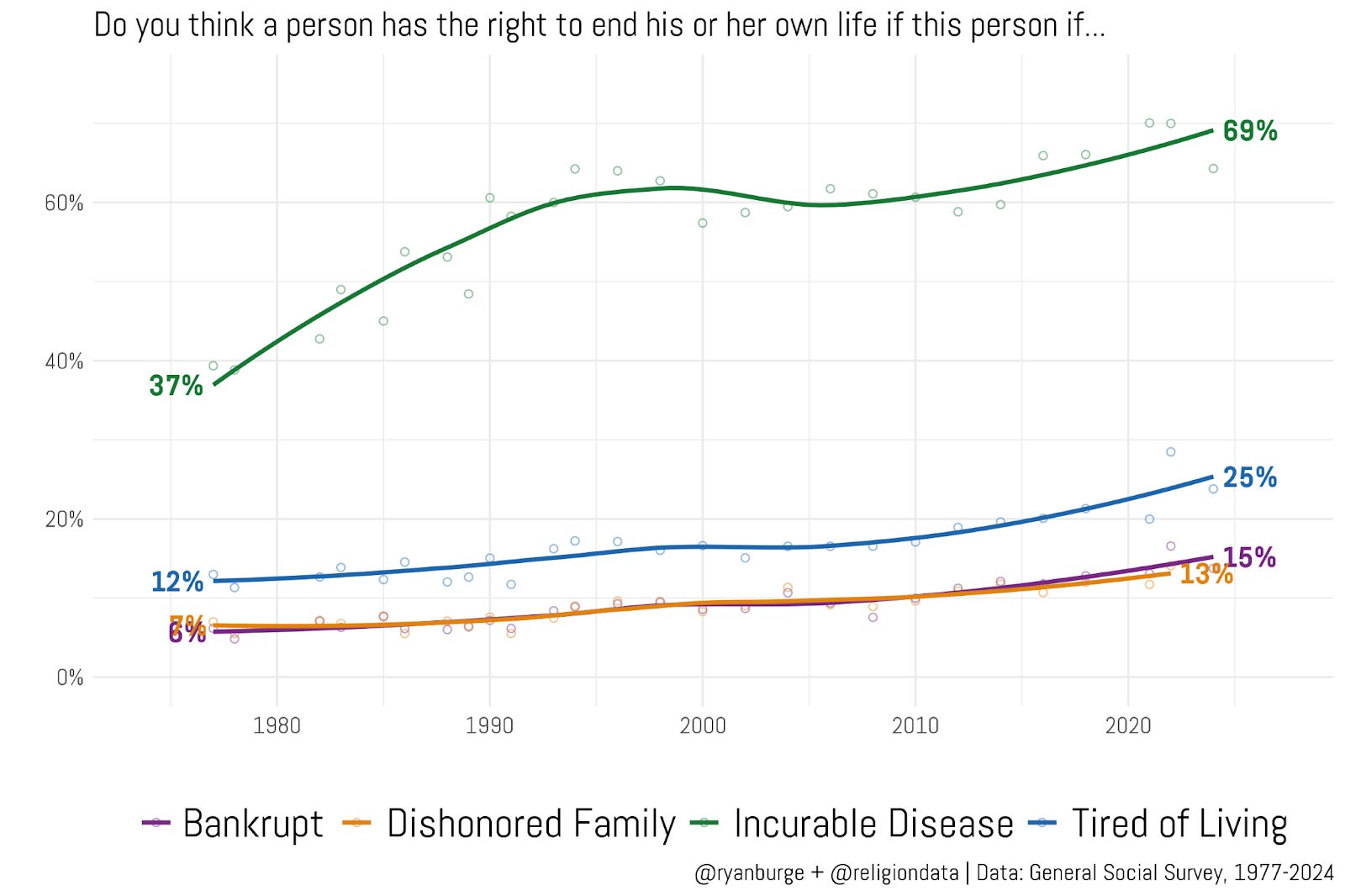
Here’s the share of the entire sample who supported a person’s right to end their life given the above circumstances.
It is clear that the American public has been much more open to the idea of suicide in the case of incurable disease compared to the other three situations. In 1977, 37% of the sample supported someone ending their own life if they had a disease that couldn’t be cured. That rose quickly through the next 15 years, crossing the majority support threshold by the late 1980s and rising to 60% in favor by the mid-1990s. It stayed there for a while but then rose again after 2010 and it’s now at an all time high: 69% in favor.
The other three scenarios have never garnered anywhere near the same levels of support in the general public. The share who favors a right to suicide for people who go bankrupt or dishonor their family has never been robust: 6-7% back in the 1970s and creeping up very slowly over time to where it now stands, around 15%.
The question about suicide when a person “is tired of living and ready to die” gets a bit more support, though. It was 12% back in 1977 and that share has doubled in the last couple of decades. Now, a quarter of Americans favor an individual ending their own life if they just don’t want to live anymore.
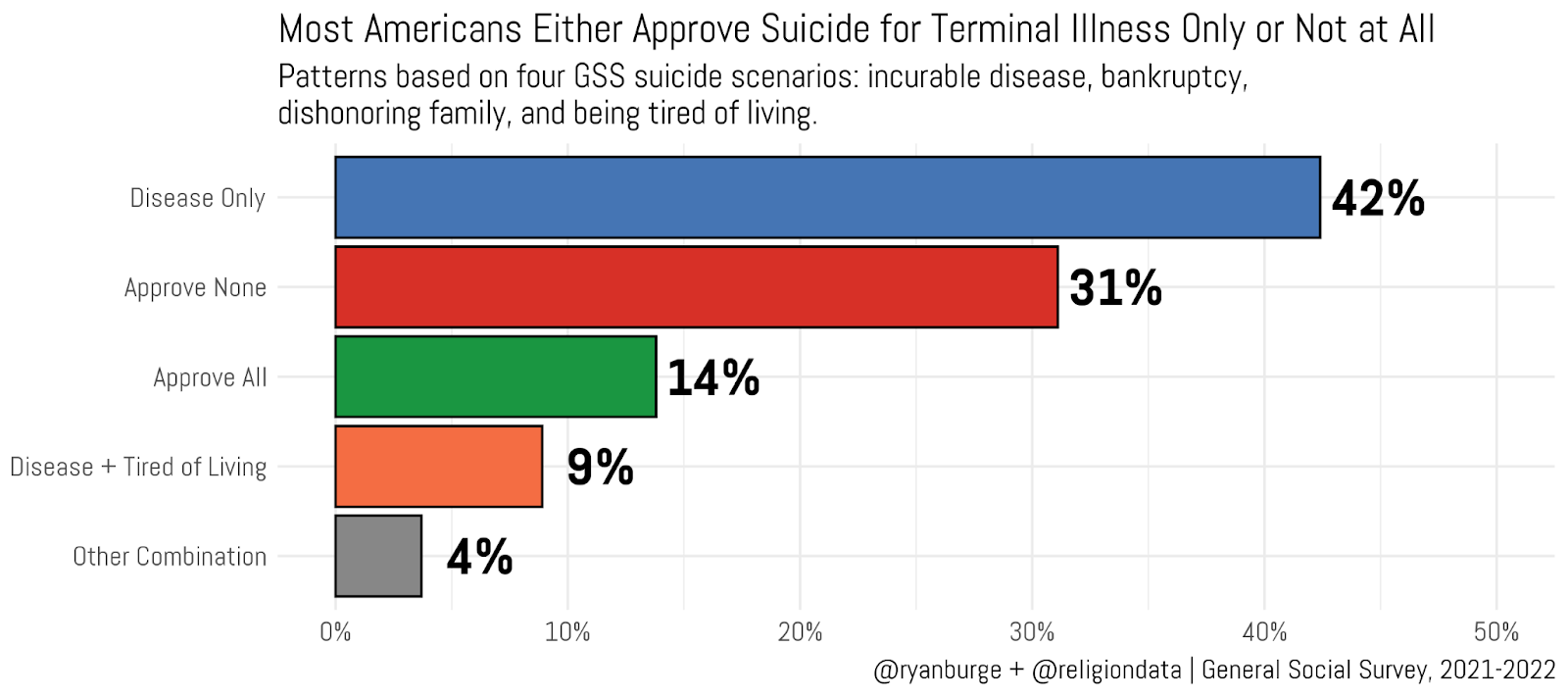
As I was poking around this data, I had to wonder: is there some kind of combination between these four scenarios that is the most popular? Or are people pretty absolutist about this: they either favor suicide in all cases or reject it in all cases?
The most popular option was an individual saying that they would favor suicide in the case of incurable disease but in no other circumstances. That position comprised 42% of the sample. In second place, with 31% of the sample were folks who simply said “no” to each of the four circumstances. They were not in favor of suicide no matter the situation. That’s much higher than the portion of the sample who took a more libertarian view and would allow someone to end their life in all four scenarios previously described (14%).
Clarence Thomas on Progressives vs. The Declaration
Progressivism seeks to replace the basic premises of the Declaration of Independence, and hence our form of government. It holds that our rights and our dignities come not from God, but from the government. It requires of the people a subservience and weakness incompatible with a Constitution premised on the transcendent origin of our rights.
You will not be surprised to learn that the progressives had a great deal of contempt for us, the American people. Before he entered politics, Wilson would describe the American people as “selfish, ignorant, timid, stubborn” and “foolish.” He lamented that we “do too much by vote” and too little by expert rule. He proposed that the people be ruled by administrators who use them as “tools.” He once again aspired to be like Germany, where the people, he said admiringly, were “docile and acquiescent.”
The century of progressivism did not go well. The European system that Wilson and the progressives scolded Americans for not adopting, which he called nearly perfect, led to the governments that caused the most awful century that the world has ever seen. Stalin, Hitler, Mussolini, and Mao all were intertwined with the rise of progressivism, and all were opposed to the natural rights on which our Declaration was based. Many progressives expressed admiration for each of them shortly before their governments killed tens of millions of people.
It was a terrible mistake to adopt Progressivism’s rejection of the Declaration’s vision of universal, inalienable natural rights. Wilson’s claim that natural rights must give way to historical progress could justify the greatest mistakes in our history. In Plessy v. Ferguson, my court upheld Louisiana’s system of racial segregation because “separate but equal,” it observed, was reasonable in light of “the established usages, customs, and traditions of the people, and with a view to the promotion of their comfort, and the preservation of the public peace and good order.” It comes as no surprise that the progressives embraced eugenics. Progressives believed that Darwinian science—the idea of ever-advancing progress written into biology itself—had proven the inherent superiority and inferiority of the races. It was only a small step for Wilson to resegregate the federal workforce. It was only another step for the government to launch sterilization programs on those deemed by the experts of the day to be unfit to reproduce—upheld by my court in Buck v. Bell in an opinion written by no less a figure than Justice Oliver Wendell Holmes.
We can argue over whether you believe in immutable, absolute natural rights or the Wilsonian idea of ever-progressing history. . . . But let me ask you to consider the consequences. European thinkers have long criticized America for remaining trapped in a Lockean world, with its weak decentralized government and strong individual rights. They say our 18th-century Declaration has prevented us from progressing to higher forms of government. Why has America never had a socialist party, one German sociologist famously asked. But we were fortunate not to trade our Lockean bounds for the supposedly enlightened world of Hegel, Marx and their followers. Fascism—which, after all, was a national socialism—triggered wars in Europe and Asia that killed tens of millions. The socialism of the Soviet Union and the People’s Republic of China proceeded to kill more tens of millions of their own people. This is what happens when natural rights give way to the higher good of notions of history, progress, or, as Thomas Sowell has written, the “vision of the anointed.”
None of this, of course, was an improvement on the principles of the Declaration. Tocqueville’s “Democracy in America” is largely about how America owed its superiority over Europe to its conscious decision to reject central planning and administrative rule root and branch. Progressivism, in other words, is retrogressive. As Calvin Coolidge said on the 150th anniversary of the Declaration:
“If all men are created equal, that is final. If they are endowed with inalienable rights, that is final. If governments derive their just powers from the consent of the governed, that is final. No advance, no progress can be made beyond these propositions. If anyone wishes to deny their truth or their soundness, the only direction in which he can proceed historically is not forward, but backward toward the time when there was no equality, no rights of the individual, no rule of the people.”
“Technology can be our best friend, and technology can also be the biggest party pooper of our lives. It interrupts our own story, interrupts our ability to have a thought or a daydream, to imagine something wonderful because we’re too busy bridging the walk from the cafeteria back to the office on the cell phone.”