It is hot, hot, hot in Dallas. I’ll have a longer article about takeaways from this convention when it’s over, but right now it’s just too hot. It’s so hot you can come up with crazy ideas like promising people a $5,000 payment if they re-elect Republicans. But that doesn’t mean we aren’t talking about it, which we are all day long at The Daily Wire’s BaRNC at Hero Bar across from the arena. Click here to watch our District Club kickoff yesterday:
The president and former reality TV star hatched the idea for the convention and put himself in the starring role. It was impossible to walk around American Airlines Center without seeing Trump’s image—large photos covering the walls, T-shirts, and even the event credentials hanging around attendees’ necks.
Trump delivered a trademark nearly-two-hour speech, boasting about the crowd size—despite visible empty seats throughout the arena—and ticking through his favorite subjects, including false claims of winning the 2020 election. He mused about changing the name of New Mexico to New America, defended the war in Iran and paid tribute to Charlie Kirk, the conservative activist who was assassinated a year ago.
But the most eye-catching part was Trump’s promise to give a $5,000 “dividend” to all American adults if Republicans maintain their majorities in the House and the Senate. He said the money must be spent in the U.S. Such a dividend would likely need to be approved by Congress.
The White House didn’t immediately respond to a request for more details about the proposal. Giving every American adult $5,000 would cost more than $1 trillion. Trump suggested the money could come in part from revenue from tariffs.
The term-limited president implored the audience to think of him as on the ballot in November and said he would travel the country on behalf of candidates in tough races. One of those candidates is Texas Attorney General Ken Paxton, who is running for Senate and has drawn complaints from Republicans of a lackluster campaign. Trump made fun of the way Paxton looks, speaks and dresses, but praised him as a fighter.
Republicans are betting that putting Trump at the center of the midterms will help convince the president’s conservative supporters to show up at the polls in November. But Trump’s approval rating is below 40% in most polls, and the all-Trump-all-the-time strategy could drive away independent voters.
Sen. John Fetterman (D., Pa.) delivered the first surprise moment of the convention when he appeared by video, boosting Republican hopes of convincing voters the Democratic Party has gone too far left. “Why am I here talking to you today? Because, well, I’m a common sense Democrat,” he said. “I’m always going to reject the extremes in socialism and that anti-American way of life.” Fetterman touted bipartisan work with fellow Pennsylvania Sen. David McCormick on preserving the state’s steel industry, adding “We’ll work with President Trump.”
Fetterman’s popularity among Democratic voters has plummeted since his election in 2022 as he has become increasingly vocal in his criticism of his own party and has offered staunch support for Israel. A recent Wall Street Journal report found that Fetterman, once viewed as a progressive populist, has shirked many of his responsibilities as a U.S. senator.
His video appearance only further angered Democrats and fueled speculation that he may switch parties, though Fetterman said in a statement that he wouldn’t leave the party if Democrats flip the chamber in November. Pennsylvania State Rep. Malcolm Kenyatta, a vice chairperson of the Democratic National Committee, compared Fetterman to Benedict Arnold.
Even though the moment drew much attention in political circles, Fetterman’s video message received a muted reaction from the crowd at the convention.
he 25th anniversary of the massacres of September 11, 2001, brings with it a flood of memory, and regrets. The simple reality, visible at the time and brought into ever-sharper focus across each successive year, is that the enemy in al-Qaeda achieved its major strategic objects in its attack upon the United States of America. Although the day itself saw the virtues of Americans in aggregate brought to the fore — most especially in the raw heroism of the Flight 93 passengers, but also in the selfless sacrifice of the FDNY, NYPD, and unnumbered Americans known and unknown who saw death for themselves and gave in the hope of life for others — it also illuminated with great rapidity the strategic incapacity of American political leadership. It is an incapacity yet to be fully repaired.
Although I am not a New Yorker, I was by circumstance present in New York City the day of the massacres. My then-fiancée, working on Water Street, saw it all up close and lived a harrowing morning: the second aircraft plunging into the World Trade Center tower, a descent in panic down her own skyscraper’s elevators to the ground floor, an emergence onto a street with flaming debris cascading downward, and in an episode we still invoke in wonder today, a 15-minute wait for a payphone so she could call me and ask what to do. My counsel was to get out of lower Manhattan, preferably by train. She caught the last train to Brooklyn, alone in a car with a man who had clearly also escaped the chaos. He said aloud that it was a shocking accident. She replied that it wasn’t an accident: she’d seen it, and it was an attack. The man buried his face in his hands and wept.
When she arrived home, she had flecks of ash in her hair.
There was a lot of ash on the clear blue morning of September 11, 2001. The skies were strewn with the detritus of murder. Even before the towers collapsed, you could see the white and flashing twinkling of papers thousands of feet aloft, fluttering against the azure and the gray of the smoke. Everyone in the path of the northwesterly wind got something from the bloodied sky. We received Nynex billing records on our patio. A business two blocks away received an in-flight safety card from one of the doomed aircraft. When the towers finally did collapse, the plumes of their deaths erupted forth the quotidian stuff of the work and lives extinguished. Walking to the Brooklyn Promenade, we saw a singed manila folder descend from the heavens right in our path.
On the Promenade itself, the black pillars, the ashes of several thousand slaughtered Americans — I wondered in the moment if we had just surpassed Antietam — rose ever upward. The crowd was hushed, shocked, muted but not silent. A young man’s voice rose above the rest, strident and insistent: “The people who did this are still out there. They are still out there!”
They still are.
We were not, however, going to get those people, and this I divined quickly and with disappointment. The motivation and religion, one and the same, of the killers were swiftly proclaimed, and its rootedness in their faith and heritage was easily discerned. Yet within a week the president of the United States instructed Americans to turn away from the obvious conclusions: an act of historical revisionism undertaken in real time for reasons both ideological and prudential. The generations-long project of desacralization of the American public square, and the eradication of American particularity as an intrinsic value, left American elites and governance wholly unequipped when an explicitly religious tradition of warmaking with 14 centuries of its own inheritance slaughtered thousands of our own. We stared down the abyss of jihad and responded as if undertaking Reconstruction.
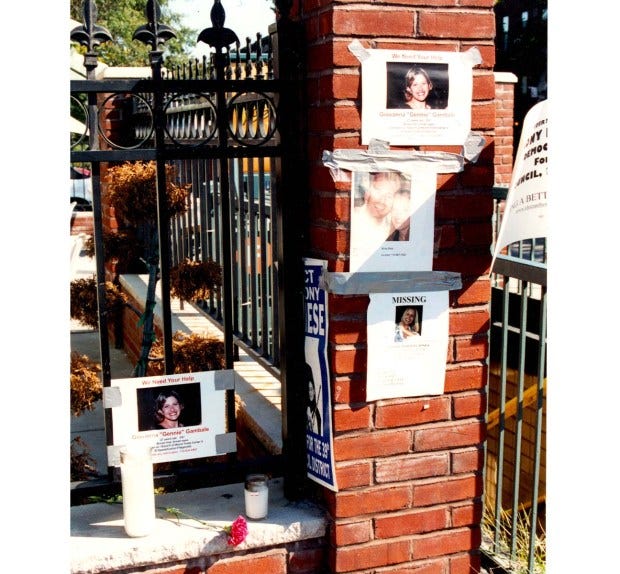
Missing-person posters for victims of the September 11 attacks (Photo courtesy of the author)
In the days that followed, our neighborhood and every other in New York City were plastered with photographs of the dead, posted in vain hopes of finding survivors, a last act of love and faith by those condemned to live. The horror and the sorrow suffused everything, and we received our condolences from those outside the city. But we needed none. We were alive. Our families were alive. Elsewhere, in New Jersey and Staten Island and Queens and in fire stations and in schools and in homes where little children asked why daddy never came back from work, or why mommy kept playing the last message from the answering machine over and over and crying, they needed the prayers and the sympathies. They needed a nation that would vindicate them — not just in care, though care they deserved in full, but in blood.
As ignorant kids watching television in a barn loft in Maryland, it felt as though the entire sky might be full of hijacked aircraft.
Even the towers falling didn’t register for me as the singular, heart-stopping moment it appears in retrospectives now. It was almost beside the point.
Because by then, something I had believed in as firmly as I believed in anything was being eviscerated.
The America I had grown up in, safe, free and impenetrable, was disappearing on a clear, beautiful September morning.
And that childlike, almost comical ignorance I possessed that day would never be permitted to return again.
It’s been 25 years of knowing that anything could happen. Any day, any perfect morning could turn into hell on earth.
But over the years I have learned many things because of that morning.
It’s not luck that we haven’t had a repeat of that day. It’s vigilance, advocacy, strategy, policy, alliance, and yes – war, that have kept the door closed. It’s not guaranteed.
I have now spent years reading about the people who attacked us that morning, trying to understand what they believed, why they hated us, how they got access and opportunity, and the threats that remain. Maybe I would have found my way here anyway.
I’ll never know.
I envy something about generations too young to remember September 11. They cannot know what it was like to possess the almost absurd confidence in our own security that so many of us had before 9:03 that morning.
For thousands of families, the horror of that day was unimaginably greater. They lost parents, children, spouses, siblings, and friends.
I didn’t lose anyone I loved on September 11.
What I lost was much smaller.
I lost the certainty that another ordinary Tuesday would always come.
At 8:55 that morning, I was an 18-year-old girl in yesterday’s clothes, hungover, laughing at the idea that I might be watching the news. My biggest concern was making it to my first shift at Best Buy.
Eight minutes later, I watched an airplane disappear into the side of a skyscraper full of people.
Twenty-five years have passed. I know much more about that world now. I know the names of the men who attacked us. I know what they believed. I know what it takes to keep people like them from doing it again. And I know that the safety I once took for granted was never guaranteed at all.
But sometimes, when I think about September 11, I don’t think first about terrorists or wars or falling towers.
I think about that girl in the barn loft.
I think about how completely safe she believed she was.
And I wish, just for a moment, I could give her back the world she thought she lived in.
The White House is shrugging off the internal Republican tension kicked up by its still-unreleased proposal to divert federal childcare aid to stay-at-home parents.
The plan, which would route some money from the government’s $12 billion childcare fund to help married parents who don’t work, reflects the rising power of a GOP wing that’s occasionally willing to abandon party orthodoxy on the size of government in order to appeal to the working-class base that helped elect Trump.
It’s drawing praise from conservative commentators like Terry Schilling of the American Principles Project who argue that it boosts family formation. Its critics on the right, including radio host Erick Erickson, counter that President Donald Trump should focus on cutting government subsidies instead.
While the fierce debate plays out online, the Trump administration has yet to answer key questions about the idea, such as whether it wants Congress to add money to the childcare fund. And for now, some inside and around the White House seem to view the plan’s opponents as irrelevant establishment voices…
This person predicted that polling would show overwhelming support for the plan: “We all agree that big government is bad, but this isn’t a question of whether we spend this money. It’s already been appropriated. It’s a question of whether we use it to incentivize nuclear families or to incentivize single motherhood, which is how it is currently constituted.”
A White House official told Semafor that the plan is not yet finalized and dismissed the early pushback as “playing no role” in the work on it.
It’s also not clear whether any eventual plan would resemble the draft proposal that leaked last week. Though Trump campaigned in 2024 on a promise to make IVF free for women seeking to build families, for example, his administration has so far limited government IVF support to discounted drugs and recommendations for how to lower out-of-pocket costs.
“September 11 was a day of de-Enlightenment. Politics stood revealed as a veritable Walpurgis Night of the irrational. And such old, old stuff. The conflicts we now face or fear involve opposed geographical arenas, but also opposed centuries or even millennia. It is a landscape of ferocious anachronisms: nuclear jihad in the Indian subcontinent; the medieval agonism of Islam; the Bronze Age blunderings of the Middle East. … The champions of militant Islam are, of course, misogynists, woman-haters; they are also misologists — haters of reason. Their armed doctrine is little more than a chaotic penal code underscored by impotent dreams of genocide. And, like all religions, it is a massive agglutination of stock response, of cliches, of inherited and unexamined formulations.”