

Read Jenna Stocker’s latest at The Daily Wire:
“Fly me to the moon,” Frank Sinatra sang in 1964, “Let me play among the stars.” The song was recorded more than 100 times before Sinatra’s version appeared on his album, It Might as Well Be Swing. It was released one year after President John F. Kennedy was assassinated. In another five years, Sinatra’s recording would play on a Sony TC-50 portable cassette player on the Apollo 10 mission, which orbited the Moon in May 1969.
It was fitting that the biggest star in American entertainment — the Chairman of the Board, the leader of the Rat Pack, Mr. Las Vegas and Palm Springs — with those electric blue eyes and buttery voice, would lend his singular vocals to the mid-20th century’s consummate moment. Pop culture meets celebrity meets the American Space Cowboy in one bold, frontier-expanding, mind-blowing, breathtaking, victorious, seemingly impossible starburst adventure into the heavens themselves.
What happened to us?
Space, that final frontier, is overshadowed by the perpetual glow of screens and the mind-crushing, unimaginative “creator class” more interested in monetizing people’s brain synapses through cat memes and AI slop bots.
At one time, astronauts ruled the covers of glossy magazines, nightly newscasts, and film reels. The nation hung breathlessly on NASA updates during our Cold War battle with the Soviet Union. It was a unique convergence of nerd-meets-jock as America’s brightest minds built a pathway to space helmed by the country’s daredevil real-life rocket men who practically double-dog dared each other to blow Death himself a kiss behind the throttles of experimental planes as post-WWII test pilots. These men had the Right Stuff, and Americans were cheering them every step of the way because the very existence of the free world and the American way of life was at stake.
At the time, astronauts and just about anyone in NASA’s orbit could be included in the celebrity-hero category. Even astronauts’ wives piqued the American people’s curiosity and subsequent press coverage. They were the first “Real Housewives,” but with a more wholesome, patriotic plotline.
Now, famous-for-being-famous is the truthism of our time. Celebrity is not much more than a slurry of performative indulgence, self-important fame whoring, and personal branding. One needs to look at Jeff Bezos’s foray into civilian space travel to see this in action. It was a real cast of characters in the worst all-female remake of a space adventure imaginable. The Girl Power Space Cadets — launched into a few minutes of weightlessness via the Blue Origin spacecraft — were powered by Bezos, who seems plenty happy to orbit his wife’s celestial spheres and send her, in a nod to Jackie Gleason’s Honeymooners character Ralph Kramden, “To the moon!” in addition to making those same celebs angry about buying his way into Monday evening’s Met Gala. What’s a billionaire to do?
No, these aren’t heroes, and they barely qualify as celebrities, even by today’s standards. The real astronauts, the ones who should be cruising down New York City’s Fifth Avenue in a ticker-tape parade, who should be invited to speak at every college and university commencement address this graduation season, who should be the star of every party and never have to buy a beer at one ever again, are the Artemis II astronauts. Sure, they didn’t actually land on the moon, but they reached farther into the depths of space than any human ever. They witnessed the Earth set behind the moon. They didn’t listen to Dark Side of the Moon; they experienced it. It was the first crewed flight beyond low Earth orbit since Apollo 17 in 1972, and everyone just shrugged.
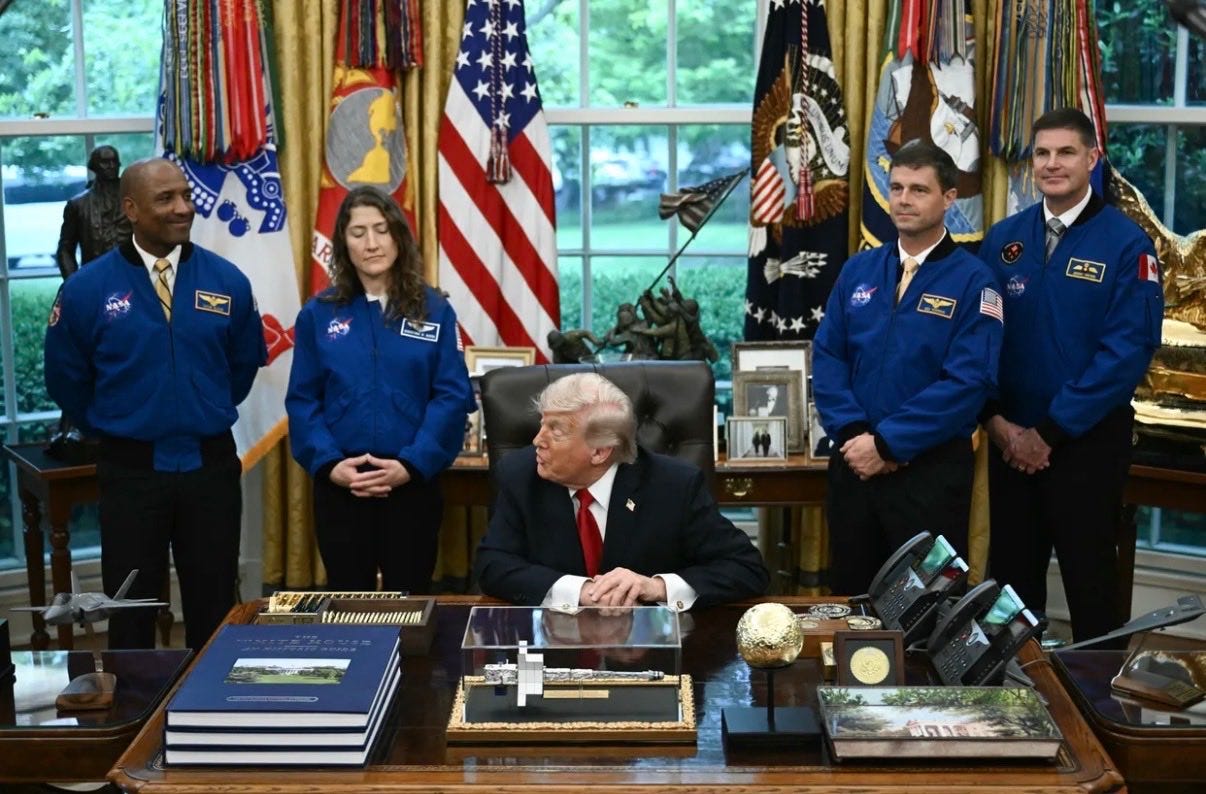
In fact, when the four-man crew (Victor Glover, Christina Koch, Jeremy Hansen, and Reid Wiseman) recently appeared in the Oval Office standing behind President Donald Trump, not a single question was directed at them by the press. The late comedian-prophet Norm Macdonald is nodding with knowing disappointment from the great beyond.
Even when the press asks the Artemis II crew questions, they center on an identity-based narrative rather than the enormity of the accomplishment. To his credit, Victor Glover has redirected this messaging toward an American experience and achievement rather than on his being a black man. We should expect as much from the press and fame ecosystem, where what passes for being a celebrity or an admired entertainer is their “influencer” status.
Read the rest. It should not be lost on us that the Artemis II astronauts got 20 minutes in the Oval Office and no journalist even asked them a question.
MAHA’s Farming Retreat
What is regenerative agriculture? The name feels concerningly evocative of the corpo-slop buzzwords (sustainability, green bonds, climate change, ESG, etc.) that we left behind in November 2024, but it actually does mean something. It’s basically a way to keep soil healthy. These farmers aim to reduce chemical usage as much as possible and plant “cover crops” that act as “living mulch” — essentially keeping land more fertile over time, and producing much tastier food.
Sovereignty Ranch is a sandbox for these regenerative strategies. The enclave was founded in 2021 by siblings Ryland and Mollie Englehart, who had spent their past lives operating a series of vegan restaurants in Los Angeles and working at environmental NGOs and non-profits. In the midst of COVID, they renounced their Californian ways and moved east to Texas, where they now run a thriving cattle ranch, eat meat, and work to reduce chemical-intensive farming.
Like many MAHA touchstones (raw milk, vaccine skepticism), regenerative farming is kind of crunchy and countercultural — a feature reflected in their merchandise: a “2nd Amendment Hippie” shirt featured a wild-haired hippie girl holding up an AR-15. Another shirt: “Raw Milk: The Real White Privilege.”
Between regenerative organic cheeseburgers and speeches from MAHA evangelists, a group of male activists from Southern California asked me whether I’d ever done psychedelics. When I shamefully confessed that I had not, they provided a lengthy instructional tutorial on microdosing.
As I made my way to a presentation on clean butchery, I discussed King Charles’ support of regenerative agriculture with a well-dressed Englishman, who explained to me that he’d quit his corporate job to meditate in India for a decade before joining a bioherbicide company that sought to unseat the dominant herbicides of Glyphosate and Diquat and replace them with a MAHA-approved alternative.
Other conversations ranged from optimistic preaching about the newest superfood mushroom or supplement powder to angry rants about data center construction, Palantir’s recently inked deal with the USDA to centralize farmer data, and cloud seeding in the Great Salt Lake (featuring hats that read “Make Clouds Real Again”).
Taiwan’s Defense Budget Fight
To understand this dispute, one must understand the three primary paths Taiwan takes to acquire weaponry.
The first path is Foreign Military Sales (FMS), overwhelmingly from the United States. This is a straightforward government-to-government transaction. Taiwan submits a request, the US government conducts political and military assessments, the State Department manages the diplomatic timing, and the Department of Defense, DSCA, and relevant services handle execution, pricing, delivery, and logistics.
The advantage of FMS is a clear chain of accountability. However, FMS has never been a purely commercial transaction; it is always a segment of the United States’ foreign policy. When Washington is engaged in strategic dialogue with Beijing, the announcement of sensitive sales may be slowed, segmented, or delayed without warning.
The timing of the FMS process is one major reason the defense budget is currently stalled. The portion of the budget with the most consensus consists of the items that have already gone through visible FMS channels, such as HIMARS and Javelin missiles. These are easier for the legislature to accept because the nature of the deals is obvious, the link to US government supervision is evident, and the accountability chain is discernible. The real friction begins as the budget moves toward the higher mark that is expected to include advanced FMS items like PAC-3 MSE and the Integrated Battle Command System. If these had already been formalized through the FMS process, the special budget would have high legitimacy, and the legislature might well have approved the funds by now. However, because these FMS cases have not yet been finalized, a political and procurement vacuum has emerged. Into that vacuum have stepped DCS proposals, domestic manufacturing schemes, and various middlemen.
The second path is Direct Commercial Sales (DCS), through which the Taiwanese government signs a contract directly with a US manufacturer. In a “true” DCS arrangement, the Taiwanese government contracts directly with a US defense manufacturer or exporter, rather than routing the purchase through a local prime contractor. Liability for delivery, warranties, maintenance, and upgrades remains with the US original equipment manufacturer (OEM).
DCS is more flexible and often faster than FMS. If the prime contractor is a reputable US firm, the chain of responsibility is clear, and the pricing is verifiable. This can be a viable solution that satisfies Washington’s demand for higher spending while avoiding FMS delays. The harder question is whether the State Department and the Pentagon are prepared to endorse newer or less proven defense contractors in sensitive DCS arrangements.
But the most critical issue Washington must address is the often-neglected third path: domestic commissioning and indigenous production.
The Cultural End of the Useless Dad?
Capcom’s recently released title Pragmata has already been dubbed a “dad simulator” by gamers. The game sold over 1 million copies (at $60 a pop) in two days. Pragmata follows Hugh, a man tasked with protecting and guiding a naive young (android) girl through a hostile environment. Beneath the sci-fi combat, players have been drawn to something more resonant: the protective instinct, the mentorship, and the pride of helping someone grow. In short, the best parts of being a dad.
This isn’t an isolated phenomenon. Games such as The Last of Us and God of War have already demonstrated how powerful fatherhood narratives can be. But Joel and Kratos are reluctant, grief-shaped fathers. They remain emotionally distant and walled-off. Hugh, by contrast, takes genuine joy in his pseudo fatherhood. The “sad dad” archetype is giving way to something warmer, and the market response to Pragmata suggests audiences are hungry for it.
Video games have always found success as power fantasies with aspirational characters. Now, a significant part of that aspiration includes fatherhood.
Why now? Traditional markers of male achievement, such as home ownership, seem unobtainable. The economy feels oppressive, and the cultural narratives that once gave men a clear sense of purpose have grown thin. Masculinity is demonized relentlessly, and young men feel it. Fatherhood offers something concrete: a person who truly needs you and values your very existence. It is no surprise that social media is filled with videos of fathers coming home to hugs from excited children, often captioned with the sentiment, “Other men may be wealthy. This man is rich.”
✍️ Feature

🌍 Foreign
Wall Street Journal: Live Coverage of Iran and the Strait of Hormuz Crisis
Wall Street Journal: Attacks on U.S. Warships in Strait Test Trump’s Desire to End Iran War
Semafor: Inflation Concerns Spike Globally Amid Iran Standoff Drags
Politico Europe: Europe Fears Putin Sees Window of Opportunity to Test NATO
RealClearWorld: Western Europe Needs to Strengthen Its Defense Strategy
Brussels Signal: To Win Victory in a Democracy, Just Give the People What They Want and Need
🏛️ Domestic
Washington Examiner: The Mysterious Principles of Barack Obama
Semafor: ‘I Don’t Completely Fit In’: John Kennedy Keeps Republicans Guessing
Daily Wire: ‘Kamikaze Dolphins’? The Daily Wire Asks Trump Admin What Everyone Wants to Know
Daily Wire: JD Vance Vows Crackdown After Daily Wire’s Ohio Medicaid Investigation
Mediaite: Trump Offers John Fetterman ‘Total and Complete Endorsement’ If He Joins GOP
ABC7: Eric Swalwell Faces Allegations From More Than a Dozen Women
New York Post: Cornell President Accused of Injuring Students After Israel Debate Clash
📰 Media
Daily Wire: Daily Wire Snags Two Awards for ‘Outstanding’ Podcast and News Reporting
Hollywood Reporter: New York Magazine Bid From James Murdoch
Daily Wire: In Tucker Carlson’s World, It’s Not America First — It’s Tucker First
💻 Tech
🧬 Health
✝️ Religion
🎭 Culture & Hollywood
Hollywood Reporter: ‘King of the Hill’ Season 15 Sets Premiere Date
Hollywood Reporter: ‘The Mandalorian & Grogu’ Reactions Pour In
Variety: ‘The Bear’ Surprise Episode Brings Back Jon Bernthal
Variety: ‘The Boys’ Series Finale to Hit Movie Theaters in 4DX
Variety: First Trailer for Nolan’s ‘The Odyssey’ Reveals Cyclops and Pattinson
🪶 Quote
“Hello, Artemis II! This is Apollo astronaut Jim Lovell. Welcome to my old neighborhood! When Frank Borman, Bill Anders, and I orbited the Moon on Apollo 8, we got humanity’s first up-close look at the Moon and got a view of the home planet that inspired and united people around the world. I’m proud to pass that torch on to you — as you swing around the Moon and lay the groundwork for missions to Mars … for the benefit of all. It’s a historic day, and I know how busy you’ll be. But don’t forget to enjoy the view. So, Reid, Victor, Christina, and Jeremy, and all the great teams supporting you – good luck and Godspeed from all of us here on the good Earth.”
— Jim Lovell